












Making Sense of the Commercial EV Transition

The UK’s commercial vehicle sector is steadily electrifying. Electric light commercial vehicle registrations rose by more than 30% last year. OEM supply is growing. Government support is evolving, from the extension of the Plug-in Van Grant to new depot charging incentives and planning reforms for private charger installations. Even heavy goods transport is beginning to shift, with electric HGV adoption increasing year on year.
Yet in the light commercial segment, progress still trails national ambition. High acquisition costs, limited charging infrastructure, changing taxation, including the reintroduction of Vehicle Excise Duty for higher-value EVs, and uncertainty around operational impact continue to slow confidence. For most operators, the question is no longer whether electrification is coming, but how to introduce it without disrupting productivity, profitability or day-to-day operations.
This isn’t reluctance. It’s a reflection of how seriously operators are approaching the transition.
Fleet operators and leasing companies are typically looking at total cost of ownership, duty cycles, reporting requirements and long-term operational planning. SMEs and sole traders tend to focus on affordability, simplicity and confidence that a vehicle will do the job every day. Different starting points, but with the same underlying challenge: turning electrification ambition into something that works reliably in practice.
The next stage of commercial electrification will be defined less by technology, and more by implementation. Vehicles that suit real routes, real payloads and real vehicle life cycle expectations. Joined-up thinking that connects vehicles, infrastructure, operations and sustainability into practical transition plans.
One of the consistent messages we hear from customers and partners is that electrification advice is often fragmented. Vehicle selection, charging planning, payload management, taxation and wider operational and compliance planning are frequently addressed in isolation. The result is decision fatigue at precisely the moment the sector needs clarity.
At CPD Bodies, we see this reality every day. As a commercial vehicle conversion specialist working with sole traders through to national fleets, we sit at the intersection of chassis supply, body conversion and operational requirements. That gives us a clear view of where friction still exists, and where practical solutions are beginning to emerge.
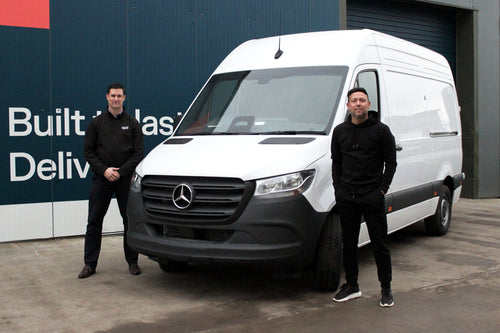
“I believe our role is to help operators navigate electrification in a way that feels achievable,” says Cathal Doocey, Managing Director at CPD. “That means joining up vehicles, infrastructure, operations and sustainability, rather than treating them as separate conversations.”
David Maguire, CPD’s Operations Director, sees this from the workshop floor as much as the boardroom. “Every conversion we build is grounded in real-world conditions. Payloads, routes, downtime, working life. That practical focus is what turns electrification from theory into everyday operation.”
Building that practical capability requires more than new products. It requires investment in infrastructure, process and skills, and a willingness to share learning across the wider supply chain.
Over the past year, CPD has been developing what will become the UK’s first fully off-grid commercial vehicle conversion facility. Scheduled to open this spring, the new workshop will operate primarily on on-site renewable energy generation, supported by battery storage and certified green electricity procurement across the wider site. Alongside expanded EV conversion capacity, the facility will include demonstration and collaboration space designed to bring together OEMs, operators, suppliers and industry partners.
For Tom Pearson, CPD’s Commercial Director and one of the driving forces behind the company’s sustainability programme, the workshop represents something bigger than infrastructure.
“Electrification isn’t just about the vehicles themselves,” Tom explains. “It’s about aligning energy, operations, supply chains and ESG reporting into one coherent system. We’ve worked closely with industry bodies, policy frameworks and supplier partners to make sure our approach is practical, credible and shareable. If we can help remove complexity for our customers, and for the wider sector, then we’re doing our job.”
This collaborative approach reflects a broader shift taking place across the industry. Positive policy announcements, expanding OEM line-ups and improving charging support schemes are all creating momentum. But for electrification to scale, operators need confidence that solutions are operationally resilient, financially sustainable and supported by capable supply chains.
That is the conversation CPD intends to lead over the coming months.
Through a series of insight articles, guidance pieces, industry discussions and open events, we will be sharing what we are learning, from early EV conversions, from infrastructure planning, from supply-chain collaboration and from customer experience. Our new off-grid facility will provide a space for partners, customers and peers to drive towards electrification together. It will be dedicated to EV panel van conversions in the main, and we’ll be working with suppliers towards delivering a true ZEV solution.
Because the future of commercial electrification will belong to those who make it workable.


