











TCO and Last-Mile Delivery: Why Electric Vans Are Now a Commercial Advantage

At this year’s Commercial Vehicle Show, fleet managers were not asking whether electric vehicles (EVs) could work in last-mile delivery. That question has largely been answered. Instead, the focus has shifted to something far more commercially important: total cost of ownership (TCO).
In simple terms, operators are no longer evaluating EVs as a sustainability initiative; they are being evaluated in terms of a financial decision.
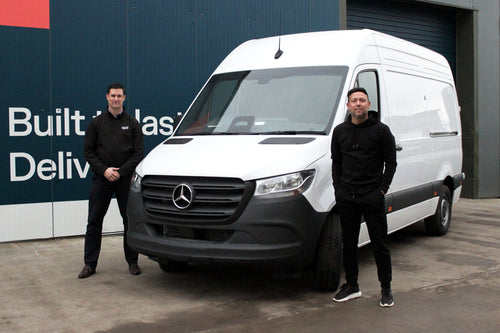
One vehicle that captured this shift perfectly was the Mercedes-Benz eSprinter at 4.25T, fitted with a tail lift, offering a usable payload of 1,055kg. The level of interest in this configuration was not accidental. It reflects a broader turning point in how electric vans are being assessed across the UK logistics sector.
Understanding TCO in Last-Mile Delivery Fleets
For fleet managers, the true cost of a vehicle goes far beyond its purchase price. Total cost of ownership (TCO) is the metric that matters, particularly in high-utilisation environments such as last-mile delivery.
TCO typically includes:
- Initial vehicle purchase and conversion
- Fuel or energy costs over time
- Maintenance and servicing
- Compliance costs such as ULEZ and Clean Air Zones
- Operational efficiency, including downtime
In urban delivery operations, where vehicles are used daily and routes are consistent, even small differences in running costs can have a significant cumulative impact.
Why Last-Mile Delivery Is Ideal for Electric Vans
Last-mile delivery is widely recognised as one of the strongest use cases for fleet electrification in the UK.
Routes tend to be predictable, daily mileage is consistent, and vehicles operate in stop-start traffic conditions that favour regenerative braking. In addition, most fleets return to a depot at the end of each shift, making overnight charging both practical and cost-effective.
On paper, this creates the perfect environment for electric vans to outperform diesel equivalents on cost. However, until recently, there has been a critical limitation: payload.
The Payload Problem and Why It Matters
One of the biggest historical barriers to electric van adoption has been reduced payload capacity due to battery weight. For many operators, particularly those transporting dense goods or equipment, this created an unacceptable compromise.
Lower payload means fewer deliveries per route. That can lead to more trips, additional vehicles, or reduced efficiency. All these outcomes directly undermine any potential TCO savings.
This is why the 1,055kg payload achieved on the 4.25T eSprinter, especially with a 500kg tail lift, is so significant. It demonstrates that, with the right platform and build, electric vans are now capable of delivering the operational performance required for real-world logistics.
Electric Van TCO vs Diesel: A Practical Comparison
To understand how electric vans compare commercially, it is useful to look at a typical last-mile delivery scenario over a four-year period, based on approximately 20,000 miles per year.
While exact figures will vary depending on the operation, the comparison below reflects a realistic UK fleet scenario:
|
Category |
Diesel 3.5T |
eSprinter 4.25T (Tail Lift) |
|
Purchase Price |
~£45,000 |
~£52,500 (incl. grant) |
|
Annual Fuel/Energy |
~£4,000 |
~£1,400 |
|
Annual Maintenance |
~£1,200 |
~£700 |
|
Compliance Costs |
~£1,500 |
£0 |
Table for illustrative purposes only.
Over four years, this typically results in:
- Diesel total cost of ownership: approximately £75,000 to £80,000
- Electric total cost of ownership: approximately £60,000 to £65,000
Even allowing for variation, the outcome is clear. Despite a higher upfront investment, electric vans can deliver a significantly lower total cost of ownership over the vehicle lifecycle.
In many cases, the initial cost difference is recovered within 18 to 24 months. After that point, the vehicle begins to generate net savings.
Why Specification Is Critical to TCO
However, these savings are not automatic.The success of an electric van fleet depends on one key factor: whether the vehicle can perform the same job as its diesel equivalent.
If payload is insufficient or the vehicle is poorly specified, the entire TCO model can break down. Reduced delivery capacity, increased journey frequency, or additional fleet requirements will quickly erode any cost advantage.
This is precisely why configurations like the 4.25T eSprinter with a tail lift are gaining traction. They offer a practical route to maintaining operational parity while benefiting from lower running costs.
The Role of the 4.25T Electric Platform
Moving from a standard 3.5T van to a 4.25T electric platform allows operators to offset the additional weight of the battery and restore usable payload.
For fleet managers, this has several immediate benefits:
- Delivery volumes can be maintained
- Routes remain efficient and predictable
- There is no need to increase fleet size to compensate for lost capacity
When combined with a tail lift, the vehicle becomes even more effective in last-mile delivery environments, improving both safety and productivity.
The Importance of the Right Conversion Partner
While the base vehicle is important, it is only part of the equation. The conversion itself has a direct impact on payload, efficient and ultimately, on TCO.
With electric vans, every kilogram matters.
An inefficiently aerodynamic or an overly heavy body can reduce payload, limit range, and increase energy consumption. These factors all feed directly into the TCO model.
This is where the role of a specialist converter becomes critical.
At CPD Bodies, the focus is not simply on building vehicles, but on engineering solutions that support real-world fleet performance. Delivering a 1,055kg payload on a 4.25T electric platform requires careful design, lightweight construction, and a deep understanding of EV constraints.
By optimising body design and integrating components such as tail lifts without unnecessary weight penalties, CPD Bodies helps ensure that electric vans achieve their intended operational and financial outcomes.
From Cost Per Mile to Cost Per Delivery
For many logistics operators, the most important metric is not cost per mile. It is cost per drop. An electric van that maintains payload while reducing running costs has the potential to significantly lower the cost of each delivery. However, this only holds true if the vehicle is correctly specified and capable of completing its route without compromise.
This is why fleet managers are increasingly looking beyond headline vehicle costs and focusing on the complete solution. The vehicle, build, and application must work together.
A Market Shift Towards Commercial Viability
The discussions taking place around vehicles like the eSprinter are no longer theoretical. Fleet operators are asking practical, commercially driven questions:
- Can the vehicle complete a full day’s work?
- Does the payload meet operational requirements?
- Will it reduce overall fleet costs?
These are the questions that define total cost of ownership. Increasingly, and as we have seen, electric vans are capable of providing the right answers.
EVs as a TCO-Driven Decision
Electric vans are no longer an emerging technology in last-mile delivery. They are a proven solution, particularly in urban and regional logistics environments.
The financial case is becoming stronger as energy savings, reduced maintenance, and compliance advantages combine to deliver a clear TCO benefit.
However, achieving that benefit depends on getting the fundamentals right. This includes selecting the appropriate vehicle platform, ensuring sufficient payload, and working with a conversion partner that understands how to optimise for electric performance.
When those elements come together, electric vans move beyond being an environmental choice and become what fleet managers ultimately need them to be: a commercial advantage.


